The Pursuit of 434: How Kapil Dev Broke Richard Hadlee's All-Time Test Wicket Record
23 November 2026 · 8 min read · The Pavilion
On a hazy Tuesday morning in February 1994, the air inside Ahmedabad’s Sardar Patel Stadium was thick with a peculiar brand of nervous electricity. For nearly two years, Indian cricket had been transfixed by a solitary number: 431. That was the benchmark Sir Richard Hadlee had carved into the stone of Test history before bowing out in 1990, an Everest of fast bowling that many purists believed would remain inviolate for a generation.
Yet here was Kapil Dev Nikhanj, thirty-five years old, his knees carrying the wear and tear of over three decades of competitive cricket, lacing his boots for the third Test against Sri Lanka. His pursuit had long ceased being merely a personal ambition; it had morphed into a national pilgrimage. Every delivery bowled in the preceding months had been watched through a magnifying glass, dissected by commentators, and cheered by millions who craved the validation of seeing an Indian bowler sit atop the world’s wicket-taking pedestal.
When Kapil finally turned at the top of his mark in the morning session, he wasn't just running in against an overseas batting lineup. He was running against time, declining pace, and the unbearable weight of expectations that only the subcontinent can manufacture.

The Shadow of Hadlee’s High-Water Mark
When Sir Richard Hadlee pinned Devon Malcolm leg-before at Edgbaston in July 1990, retiring with 431 wickets from 86 matches, he departed with an aura of surgical perfection. Hadlee’s mastery was clinical, honed on the responsive green seamtops of Christchurch, Wellington, and England's county circuit. He operated with the precision of a Swiss watch, averaging a staggering 22.29 runs per wicket.
Kapil Dev’s journey to that same territory was an entirely different beast. To understand the gravity of Kapil’s pursuit, one must confront the unforgiving geography of Indian cricket in the late 1970s and 1980s. Fast bowlers in the subcontinent were treated as sacrificial lambs—summoned to scuff up the shiny lacquer of the SG ball for three overs before handing over duties to a carousel of spinners, only to be recalled when the ball was soft and the midday sun hovered at a punishing 42 degrees Celsius.
Kapil refused that script. He forged himself into an engine of relentless stamina, sprinting across dustbowls in Delhi, baking heat in Madras, and dead tracks in Bombay. He had no fast-bowling partner of equal pedigree at the other end to share the workload, no DRS to overturn marginal leg-before shouts, and virtually zero modern sports science to preserve his sinews. That he was within sniffing distance of Hadlee was not merely an athletic anomaly; it was an act of sustained defiance.
The Long, Painstaking Final Mile
Chasing records in cricket is rarely romantic in its final stages. Between November 1992 and early 1994, the chase slowed to a grueling crawl. The explosive young athlete of the 1983 Prudential Cup had evolved into a craftsman bowling off a shortened run-up, relying on cunning, seam presentation, and subtle outswing rather than the raw, hostile pace of his youth.
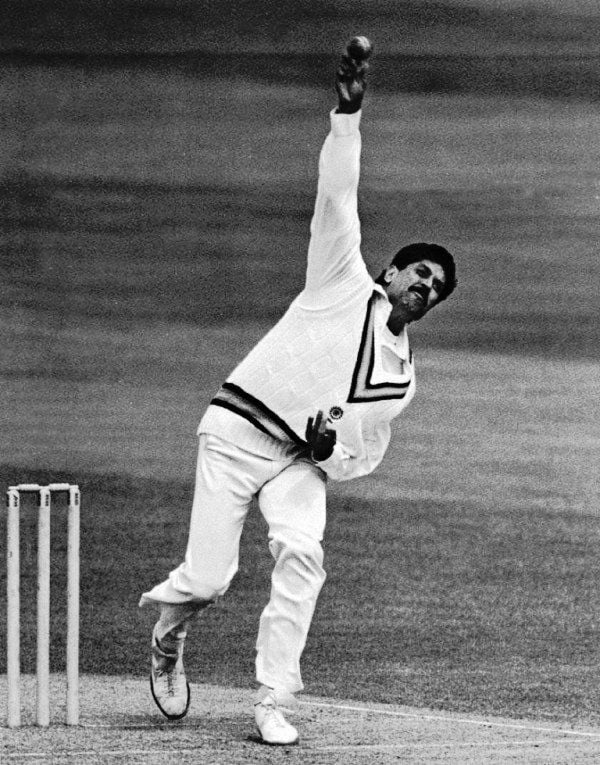
The media narrative during this phase grew merciless. Skeptics wondered aloud whether Kapil was holding back the transition of Indian fast bowling, prolonging his career purely for personal glory while younger talents like Javagal Srinath waited on the sidelines. The tension escalated with every drawn match and barren spell.
Yet, the resolve remained unbreakable. In Bangalore, during the second Test of the Sri Lanka series, Kapil drew level with Hadlee by removing Don Anurasiri, caught sharply by Mohammad Azharuddin. The milestone was touched, but the summit was still shared. The cricketing fraternity descended on Motera knowing that history was now down to a single mistake from a Sri Lankan blade.
February 8, 1994: The Ahmedabad Crucible
Sri Lanka won the toss and elected to bat on a Motera pitch that offered little early moisture. The atmosphere in the stadium was claustrophobic; every dot ball was applauded with desperate hope, every boundary met with a sharp intake of breath. Sri Lanka’s openers, Roshan Mahanama and Dulip Samaraweera, were watchful.
Kapil operated from the pavilion end with characteristic rhythm. He was not striving for sheer speed; he was searching for that elusive, late outswing that had been his calling card for sixteen years. After Manoj Prabhakar broke the opening stand by dismissing Mahanama, Hashan Tillakaratne walked out to face the music.

The moment arrived in Kapil's seventh over. Coming around the wicket, Kapil angled a delivery in toward middle and off, pitching it on a length that compelled forward defense. Tillakaratne pushed out with soft hands, but the ball gripped off the dry deck, kissed the inside edge, deflected off the pad, and looped softly toward forward short leg.
Sanjay Manjrekar, stationed under the helmet, thrust his hands forward and swallowed the catch inches off the turf.
The stadium erupted into instant, collective delirium. Manjrekar held the ball aloft as if holding an ancient relic, while Kapil leaped into the air, arms stretched wide, eyes burning with triumphant vindication. He had done it: 432 Test wickets. The summit was his alone.
432 Balloons and a Nation’s Gratitude
What followed was a spectacle uniquely Indian in its exuberance. Play was officially halted. State broadcaster Doordarshan cut away from the live match feed to show a cluster of 432 colored balloons being released into the hazy blue sky over Ahmedabad, each balloon an emblem of a hard-earned Test victim across five continents.
Kapil was mobbed by teammates, inundated by pitch-invading fans, and greeted with a standing ovation from every corner of the ground. When the legendary Sunil Gavaskar arrived on the outfield to present him with a silver platter and heartfelt congratulations, the symbolism was impossible to miss. Indian cricket had spent decades celebrated for its batting wizards and spin royalty; for the first time in history, the undisputed king of world bowling carried the Tricolor.
Kapil added two more wickets to his tally before the series concluded—ending his illustrious Test career in Hamilton with 434 wickets in 131 matches. While Courtney Walsh, Shane Warne, Muttiah Muralitharan, and James Anderson would eventually climb past that plateau into four-digit territory, none had to blaze a trail quite like Kapil Dev.
The Significance of 434 in Cricket History
In hindsight, the pursuit of 434 was more than just a statistical conquest; it fundamentally altered the psychological DNA of Indian cricket. Before Kapil, India was universally understood to be a nation that played around fast bowling rather than through it. Kapil proved that subcontinent conditions were an excuse, not a death sentence, for a fast bowler possessing supreme technique and supernatural fitness.
The record stood as a beacon for the generation that watched that Tuesday morning in Ahmedabad: Srinath, Zaheer Khan, and eventually the battery of world-class seamers that would take India to the pinnacle of Test cricket decades later.
When Kapil Dev captured his 432nd scalp at Motera, he didn't just break Sir Richard Hadlee's world record. He broke the glass ceiling for Asian pace bowling, forever redefining what was possible with a leather ball on Indian soil.
If this kind of cricket writing is your thing, we publish weekly at The Pavilion. Drop us a line at contact@kapil.dev.
Related Reading
- The Miracle of Melbourne: How an Injured Kapil Dev Defended 143 at the MCG in 1981
- Ironman of Indian Cricket: The Biomechanics and Workload Behind Kapil Dev's Injury-Free 131 Tests
- Kapil Dev’s 9/83 vs West Indies: The Tactical Anatomy of Test Cricket’s Best Bowling by a Captain
- Why the Cover Drive Is the Most Photographed Shot in Cricket