Defending 183: A Tactical Anatomy of Kapil Dev's Captaincy in the 1983 World Cup Final
26 October 2026 · 8 min read · The Pavilion
When the Indian innings folded for 183 on June 25, 1983, the consensus across Lord's was that the Prudential World Cup final was over before tea. Clive Lloyd’s two-time defending champions—boasting an unmatched batting lineup featuring Gordon Greenidge, Desmond Haynes, and the imperious Sir Isaac Vivian Richards—were widely expected to knock off the runs in fewer than thirty overs. In the press box, draft obituaries for Indian cricket’s quixotic summer were already being typed.
Yet inside the visitors’ dressing room, the mood was neither despondent nor resigned. At just 24 years old, Kapil Dev looked across a room populated by seasoned veterans and hungry outsiders and delivered a disarmingly simple message: “They gave us 183 to defend. If we can make 183, they have to score 183 to win. Let’s make them fight for every single run.”
What followed over the subsequent 52 overs was not a miracle born of blind luck. It was an exhibition of calculated, high-pressure tactical captaincy. In a format where teams were accustomed to spreading the field and waiting for mistakes, Kapil Dev went against the conventional grain. He attacked, squeezed, and out-thought the most terrifying team in cricket history.

The Psychology of Nothing to Lose: Kapil's Tactical Reset
Defending a sub-200 score in a 60-over one-day international demands an immediate shift in tactical philosophy. The greatest hazard for a fielding captain defending a low total is defensive creeping—pushing men back to save boundaries while the batting side chips away at the target in low-risk singles. Kapil knew that against an opposition with the boundary-hitting pedigree of the West Indies, containment was mathematical suicide.
Kapil’s opening gambit was psychological warfare disguised as field placement. Instead of posting deep sweepers, he stationed ring fielders on the edge of the circle and maintained close-in catchers. The message was clear: West Indies would not be permitted to jog to victory in singles. If they wanted the runs, they would have to hit over the top against an Indian attack bowling disciplined, probing lengths on a pitch that still retained moisture beneath the afternoon sun.
By refusing to concede easy strike rotation, Kapil disrupted the rhythm of the West Indian top order. The Caribbean giants were used to teams wilting in front of them; encountering an Indian side barking encouragement, diving into the turf, and crowding their eye line unsettled their early-innings composure.
The Greenidge Shock and Seam-Bowling Restraint
Kapil opened the attack with his own energetic outswingers paired with the deceptive military-medium of Balwinder Singh Sandhu. Rather than trying to match the sheer velocity of Malcolm Marshall or Michael Holding, India’s weapon was restraint.

Sandhu's early dismissal of Gordon Greenidge remains one of the iconic dismissals of modern cricket, but the setup was purely tactical. Greenidge was allowed to shoulder arms repeatedly to deliveries angled across him. Sandhu then delivered a ball that pitched just outside off and jagged back sharply off the seam. Greenidge misjudged the movement, left his bat raised, and watched his off-stump tilt backward. At 5 for 1, the seed of doubt was firmly planted.
Kapil utilized his own bowling spell not to hunt for wickets through reckless short-pitched bowling, but to tie down the off-stump channel. In an era before strict fielding circle rules, Kapil orchestrated a claustrophobic ring: cover-point, extra cover, and mid-wicket were packed to choke Haynes. India’s captain understood that scoreboard pressure has nothing to do with the total required and everything to do with the rate at which balls pass by without yielding runs.
The Richards Gamble: Empowering Madan Lal and the Running Catch
No analysis of the 1983 final is complete without the dismissal of Viv Richards, yet history often obscures the tactical chess match that preceded it. Richards had walked to the crease and immediately begun treating the target with open disdain, striking seven blistering boundaries on his way to 33 off 28 balls. West Indies had coasted to 50 for 1, and the match was slipping away fast.
Madan Lal, who had already removed Haynes for 13 but had subsequently been dispatched for boundaries by Richards, approached Kapil and demanded the ball for another over. Conventional wisdom dictated taking the battered medium-pacer out of the firing line to introduce fresh bowling. But Kapil’s captaincy was deeply rooted in instinctive player management. He saw the fire in Madan Lal’s eyes and backed his man.
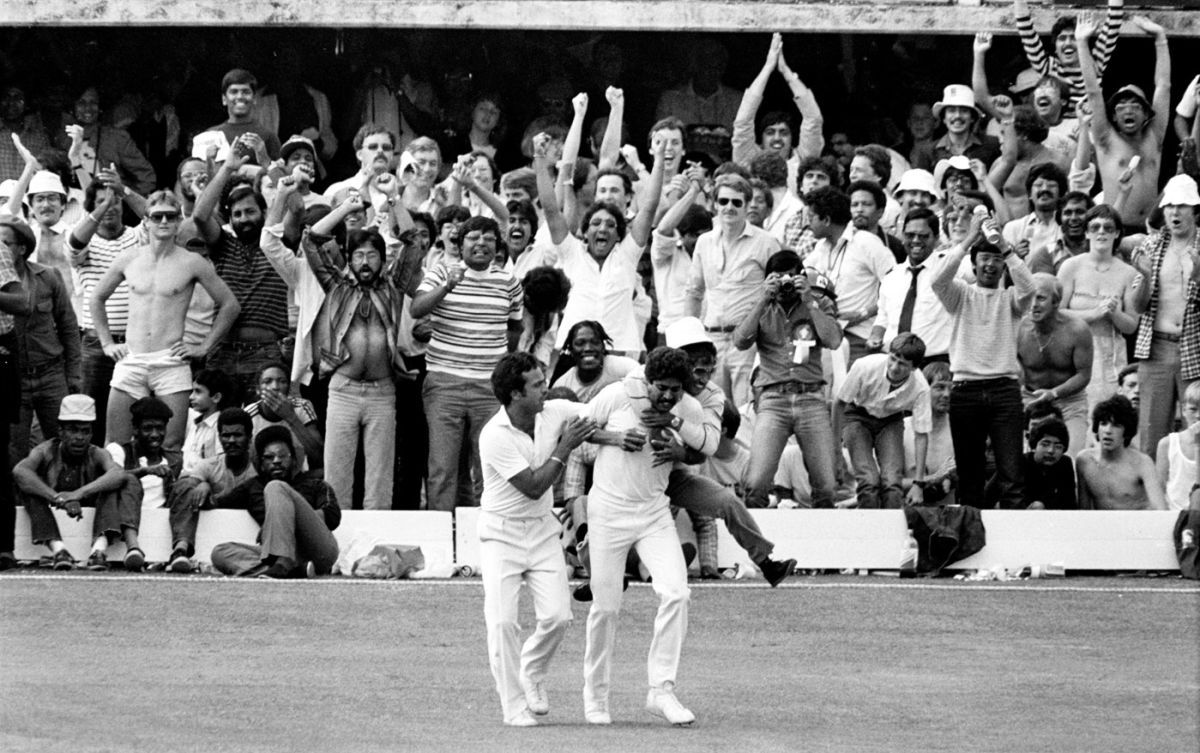
The plan was audacious: dangle the bait. Madan Lal bowled slightly short and wide outside off, tempting Richards to unleash his trademark hook. Richards took the bait, mistiming the stroke high into the overcast London sky toward mid-wicket.
What happened next was an astonishing athletic feat and tactical triumph. Kapil, stationed at mid-wicket, turned his back to the pitch and sprinted roughly 20 yards backward towards the boundary rope. Running with the trajectory of the ball, keeping his eyes fixed over his shoulder, he gathered the ball with steady hands just as it began to dip below his chest. It was the match-defining moment: India had taken the king, and the king’s castle suddenly looked fragile at 57 for 3.
Madan Lal struck again almost immediately. With his confidence surging, he found the edge of Larry Gomes’s bat, and Sunil Gavaskar snaffled the chance at slip to leave West Indies reeling at 66 for 4.
The Seam Carousel: Suffocating with Amarnath and Binny
With Richards and Gomes back in the pavilion and Clive Lloyd nursing a groin strain, Kapil ruthlessly tightened the vice. Rather than turn to raw pace, Kapil unleashed his secret weapon: the military-medium carousel of Mohinder Amarnath and Roger Binny.
Lloyd attempted an aerial drive off Binny and was caught by Kapil himself at extra cover for 8, leaving the scoreboard reading a stunned 66 for 5. Sandhu then had Faoud Bacchus caught behind by Syed Kirmani.
When Jeff Dujon and Malcolm Marshall staged a gritty 43-run counterattack to push the total to 119 for 6, Kapil refused to panic. He rotated Amarnath and Sandhu in short, sharp bursts, denying the batters any rhythm.
Amarnath’s trundling, slow-medium pace proved unplayable under the grey London sky:
- Jeff Dujon (25) chopped an innocuous-looking delivery that nipped back through the gate straight onto his stumps.
- Malcolm Marshall (18) pushed forward defensively to an away-seamer, edging it straight to Gavaskar at slip.
- Michael Holding (6) was trapped plumb in front by a sharp inswinging delivery to close the innings.
Amarnath’s spell of 3 for 12 from seven overs sealed the collapse, with Kapil having also pinned Andy Roberts lbw for 4 in between. Every bowling change had produced a breakthrough; every tactical risk had paid off.
The Blueprint: Why 183 Remains Cricket's Greatest Defensive Masterclass
When Amarnath trapped Holding leg-before to seal a 43-run victory, the pitch was engulfed by thousands of ecstatic fans. But behind the emotional euphoria lay a triumph of pure cricketing intellect.
Kapil Dev’s defense of 183 is the gold standard for low-total defenses in one-day cricket. He recognized four essential truths that day:
- Low totals require attacking fields: The moment you stop hunting wickets, you surrender the match.
- Conditions dictate tempo: Exploiting the seam and swing of Lord's in late June with military-medium accuracy was far more lethal than trying to blast the opposition out with sheer pace.
- Instinct over dogma: Trusting Madan Lal to bowl to Viv Richards went against every statistical model of the time, but captaincy is about managing people, not spreadsheets.
- Leadership by example: From his opening spell (11 overs, 4 maidens, 1 for 21) to his iconic catch, Kapil demonstrated the exact intensity and composure he demanded of his team.
Before June 25, 1983, one-day cricket was seen as a batter's playground where low totals were an inevitable death sentence. In defending 183 against the most feared batting lineup in history, Kapil Dev permanently rewrote the tactical playbook.
If this kind of cricket writing is your thing, we publish weekly at The Pavilion. Drop us a line at contact@kapil.dev.